Build
SaaS Development
From idea to subscription revenue.
- From
- KSh 450,000
- Typically
- 6–12 weeks
What is saas development, and who is it for?
SaaS development at Techmode means building a product other organisations pay to use — separate accounts, role-based access, subscription billing and an admin view. It suits founders with a validated idea and institutions turning an internal tool into a product. From KSh 450,000, in six to twelve weeks for a first release.
We help founders and enterprises build software products people pay for — multi-tenant platforms, dashboards, and subscription billing on modern stacks (Next.js, Supabase, cloud-native). Product strategy, design, and engineering under one roof.
The problem
What this actually costs you.
We run the whole thing on a spreadsheet we email around.
Other schools keep asking to use our system.
We built an MVP and it fell over as soon as the second customer joined.
What we build
The outcome, not the deliverable.
We scope every engagement around results you can measure — not line items that sit on a shelf.
- Validate and launch faster
- Recurring, predictable revenue
- Architecture that scales with you
Product strategy & MVP
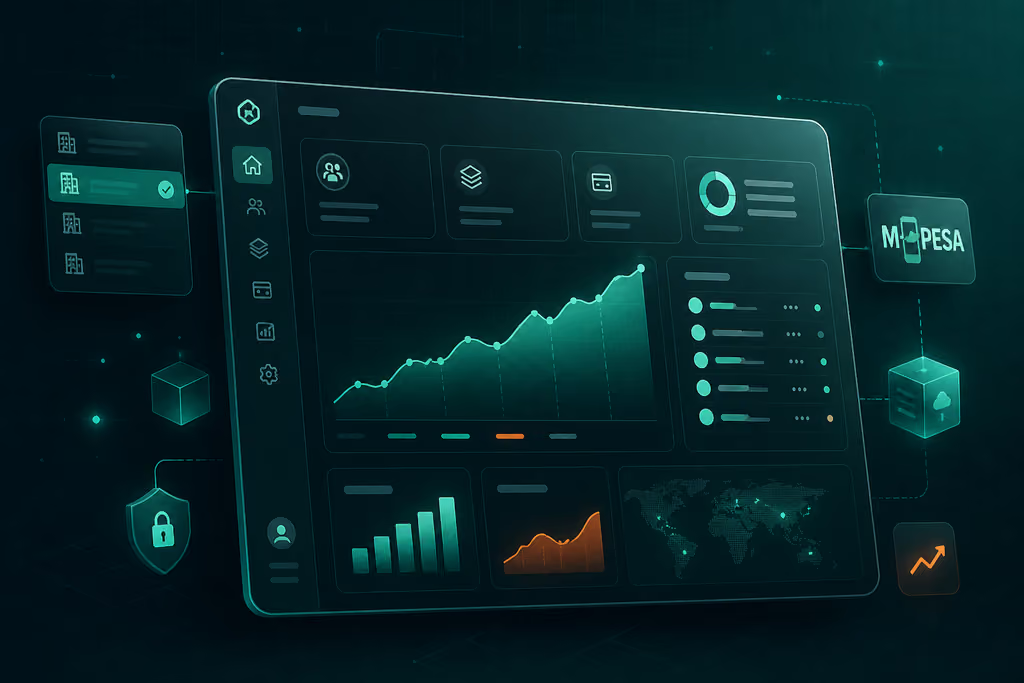
Multi-tenant platforms
Subscription & M-Pesa billing
Cloud & DevOps
Try it yourself
School fees and records
Look up a student, read the fee balance and attendance, then send a parent reminder with a paybill link.
Open the demoWhat changes
Before, and after.
| When | The old way | With Techmode |
|---|---|---|
| A new customer wants to start | A call, a manual setup, and a copy of the spreadsheet with their name on it. | They sign up, get their own space, and are working within minutes. |
| Someone leaves the organisation | Their copy of the file is still on their laptop. | Access is revoked centrally and the record of what they did survives. |
| Money comes in | Invoices chased by hand and reconciled against M-Pesa messages. | Subscriptions charge on schedule, and lapsed payment changes access automatically. |
A new customer wants to start
The old way
A call, a manual setup, and a copy of the spreadsheet with their name on it.
With Techmode
They sign up, get their own space, and are working within minutes.
Someone leaves the organisation
The old way
Their copy of the file is still on their laptop.
With Techmode
Access is revoked centrally and the record of what they did survives.
Money comes in
The old way
Invoices chased by hand and reconciled against M-Pesa messages.
With Techmode
Subscriptions charge on schedule, and lapsed payment changes access automatically.
What's included
Everything in the price, itemised.
- A scoping week that decides what the first release proves, and what it deliberately leaves out
- Multi-tenant foundations: separate accounts whose data cannot reach each other
- Roles and permissions, designed from your real job titles
- Subscription billing, by M-Pesa or card, with the plan and access states kept in step
- An admin view so you can support a customer without a developer
- Deployment, backups, error monitoring and a documented restore
- A written handover: architecture, decisions, and what we would build next
Timeline
6–12 weeks, week by week.
Week 1
Scope the first release
We decide what version one has to prove, and write down what it will not do. This is where most SaaS projects are won or lost.
Weeks 2–3
Foundations
Tenancy, accounts, roles and the data model — the parts that are painful to change later.
Weeks 4–9
Build the product
Two-week cycles on a live staging environment you can use throughout.
Weeks 10–12
Billing, admin and launch
Subscriptions, the admin view, monitoring, backups, a rehearsed restore, then launch.
Investment
From KSh 450,000, and what moves it.
SaaS Development projects start at KSh 450,000 and typically run 6–12 weeks. Every project is scoped and priced in writing before any work begins — the figure below is a starting point, not a quotation.
What pushes the price up
- Regulated data, audit trails, or a compliance regime with real obligations
- Integrations with institutions whose systems are old and slow to test against
- A first release that tries to serve three different customer types at once
What keeps it down
- One customer type, one core job, done properly, in the first release
- Managed infrastructure rather than something bespoke
- A founder who can decide quickly and does not need every decision escalated
Third-party costs — hosting, WhatsApp conversation fees, app store accounts — are yours and are named up front. See how we price for the full picture.
Get my free estimateWhere to next
Related services.
Build
Web Development
Websites that win trust and close sales.
From KSh 120,000
Build
Mobile App Development
Your business in every pocket.
From KSh 450,000
Automate
AI Automation Solutions
Put the repetitive work on autopilot.
From KSh 80,000
Built for organizations & ngos, schools & education and saccos & financial services.
Questions
SaaS Development, answered.
What counts as SaaS, as opposed to a website?
A website tells people about you. SaaS is software they log into and pay to use, where each customer has their own separate data, their own users, and their own subscription. The difference shows up mostly in the parts you cannot see.
Can customers pay by M-Pesa rather than card?
Yes, and for a Kenyan customer base it is usually the right default. We wire M-Pesa to the subscription state so that a lapsed payment changes access automatically, rather than someone checking a spreadsheet.
Do you build the MVP or the whole platform?
We build a first release that a real customer can use and pay for, on foundations that will not have to be thrown away. Trying to build the whole platform before anyone has used it is the most reliable way to waste a budget.
How is one customer's data kept away from another's?
Tenancy is built in at the data layer, not enforced by remembering to filter a query. Every record belongs to a tenant, and the tenant boundary is checked in one place rather than in every screen.
Who owns the code and the customer data?
You own both. The repository, the cloud accounts and the data are yours, and we hand over the credentials. If you later want another team to take it on, the written handover exists for exactly that.
Ready for software that wins you customers?
Book a free, no-obligation consultation. We'll map your fastest wins and show you exactly what's possible — in plain language, with clear numbers.
Prefer direct? [email protected] · +254 731 290 928 · Mon–Sat, 8am–6pm EAT